
Stouffville updates election sign regulations ahead of municipal vote
By Gene Pereira, Local Journalism Initiative reporter
Signs, signs, everywhere election signs are drawing safety concerns for Stouffville council.
In a brief special session held on Tuesday, Sept. 1, the Town of Whitchurch-Stouffville council convened for a single, focused purpose: updating the municipality’s election sign regulations ahead of the upcoming municipal elections.
The brief nature of the single-item agenda was matched only by the speed of the proceedings, as the entire meeting concluded in just under seven minutes.
The primary order of business on the single-item agenda meeting — it took less than seven minutes — was the formal passage of By-law Number 2026-073-RE, an enactment designed specifically to amend the town’s primary election sign regulations laid out in By-law 2018-050-RE.
Under subsection 11(3) of the Municipal Act, 2001, local authorities are empowered to regulate signage on local property, and Whitchurch-Stouffville elected officials deemed it crucial to act swiftly to ensure public safety on local highways and right-of-ways throughout the active campaign season.
The core adjustment is a targeted correction to Section 2(g)xii of the existing framework. The reworked by-law deletes the original wording and replaces it with a revised directive stating that no election sign shall “be supported by anything other than wooden or metal stakes or posts.”
While the change sounds administrative, the practical outcome is aimed at resolving a glaring issue for political campaigns attempting to set up temporary lawn displays.
“This is basically going to allow election signs on private property, and on public property, to use those ‘H’ brackets,” explained Whitchurch-Stouffville Mayor Iain Lovett. “It was an unintended consequence back when this by-law came forward in February that, in my mind, I was thinking, on arterial roads, wooden stakes, no problem, but we’re fixing a mess.”
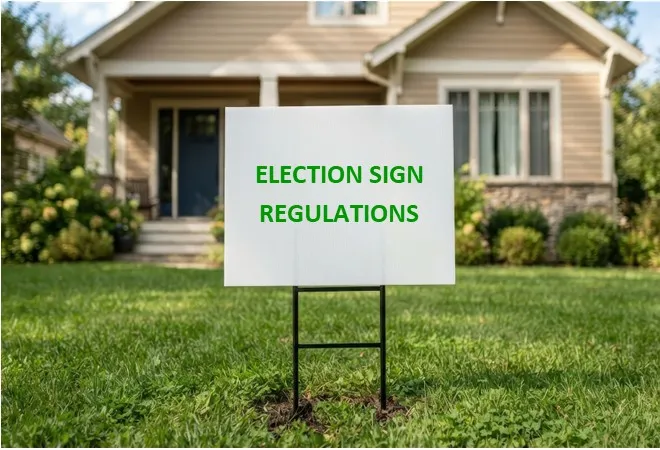
The correction allows standard lightweight wire frames and traditional “H” brackets — commonly used for corrugated plastic lawn signs — to be utilized seamlessly by local candidates across both public and private lands without inadvertently breaching town rules.
The discussion at the meeting, however, quickly turned to the broader context of why sign supports are so tightly controlled in the first place, with members of the council expressing concerns over larger installations, public maintenance hazards, and heavy-duty materials remaining in the public realm.
Ward 1 Councillor Hugo T. Kroon pointed out that regional authorities have had to navigate similar difficulties regarding sign materials and cleanup enforcement.
“I understand why the region did it,” Kroon said. “The region has a problem with signs being put on their property and not being removed, and it becomes a safety hazard, not only for the general public, but maintenance activities (such as) guys who do grass cutting and stuff like that.”
Kroon raised further safety concerns regarding the potential dangers posed by heavier, all-metal structures or deep-ground stakes left behind in public spaces.
“Is that a problem for us?” Kroon asked, inquiring whether all-metal signs left in the public space present an ongoing safety issue for town infrastructure and maintenance crews.
Derek Hannan, manager of Municipal Law Enforcement, acknowledged the potential risks associated with driving heavy post supports deep into municipal lands.
“It may become a problem with how deep somebody is hammering those metal posts into the ground, whether it’s rebar, ‘H’ bar or whatever,” Hannan answered. “That is a concern if it’s being hammered into the ground… where we have infrastructure.”
When Kroon followed up to confirm whether municipal staff actively work to ensure that improperly placed or illegal signs are removed from public property, Hannan confirmed directly: “That is correct.”
The discussion surrounding sign supports also touched on broader regional trends. Ward 6 Councillor Sue Sherban shared her observations from recent travels through other parts of the province, noting a visible shift toward heavy-duty wooden stakes on roadside displays.
“I saw lawn signs that had wood stakes,” she noted, recalling a recent trip through Port Stanley and Brantford. “Is this becoming a new process in the GTA? Does anybody know where or how? It’s just interesting the region brought it up, but now I take notice of it because I didn’t.
“Driving through, I was ‘Oh, there are wood stakes on this front lawn.’ So, I was just wondering if that’s kind of what’s happening. That maybe that’s something I think we should know if we’re back four years from now.”
Chief Administrative Officer Sunny Bains confirmed that the shift toward wooden stakes for larger signage is indeed a growing trend driven by operational and safety requirements.
“It is a pattern we’re starting to see evolve,” CAO Bains stated. “A lot of municipalities are moving towards wooden (stakes) for the reasons Councillor Kroon outlined. Where it becomes problematic for us is more so on our right-of-ways, where we have our crews going in with equipment.”
Bains added that staff had pondered splitting the rules depending on the physical size of the sign, but ultimately opted to keep things simple to avoid confusing campaign workers and candidates.
“We did contemplate whether this change would only be for the smaller signs, but we thought that would be rather confusing for a lot of candidates,” Bains explained. “So, the only nuance that will be left is… wooden stakes are still required for the region side of things.”
The formal motion to enact By-law 2026-073-RE was moved by Councillor Rick Upton and seconded by Kroon. The motion carried unanimously, officially bringing the updated rules into force.