
YRT provides more frequent services, greater fare integration
By David Yin, Local Journalism Initiative reporter
York Region Transit has implemented more frequent services, a nighttime service plan, and greater fare integration since receiving low marks two years ago from the Toronto Region Transit Report Card.
These changes have been associated with a 17 per cent increase in Markham ridership–from 4.7 million rides in 2023 to 5.5 million in 2024–as well as a 12 per cent increase in ridership towards 23.7 million rides for the entire York Region in 2024.
York Region Transit identified three main issues that the Transit Report Card highlighted: Low service coverage, lack of 24-hour service, and zero fare integration with TTC.
Published in July 2023, the Transit Report Card graded York Region a C-.
The Transit Report Card concluded less than 40 per cent of York Region residents had base service coverage–which is nearby access to transit services running every 30 minutes on weekdays. Less than 20 per cent of residents had frequent service coverage–which is nearby access to 15-minute transit services on weekdays.
Now, 16 routes boast frequent service coverage within York Region–a 25 per cent increase from 2023, according to Richard Montoya, Director at York Region Transit.
Montoya said the transit agency increased frequencies on four additional routes to every 15 minutes or faster since 2023. Frequency refers to how often the agency schedules a bus to arrive at a bus stop throughout a particular route.
These frequency improvements met the Transit Report Card’s threshold for not just base service coverage, but also frequent service coverage.
York Region Transit is also developing an overnight network as part of its 2026-2030 Business Plan. Once complete, the network will identify key routes to operate between midnight and 5 A.M. throughout an entire week.
The network will also provide York Region with a baseline towards 24-hour service–a key improvement area outlined in the Transit Report Card.
The overnight network map includes six routes as of May 2025: Lines 1, 20, 24/90, 77, 98/99, and 107B. The transit agency plans to expand the network as funding increases.
Montoya said overnight routes will be centred around job centres, “such as hospitals, employment precincts, manufacturing precincts, business parks, and industrial parks,” in collaboration with Ontario’s Regional Economic Development Branch.
Finally, York Region Transit began participating in the One Fare Program in 2024. Since its launch, the program saved riders over $123 million by minimizing all transfers between York Region Transit, TTC, Go Transit, MiWay, Durham Region Transit, and Brampton Transit.
This aligned with the Transit Report Card’s third main recommendation for York Region: To implement fare integration with TTC.
The 2024 York Region Transit Performance Report stated York Region had a 27.6 per cent increase in cross-boundary trips since the introduction of One Fare, culminating in 7.6 million trips–equal to 32.3 per cent of total ridership–that year.
Although Metrolinx and the province of Ontario planned their One Fare Program to last two years until March 2026, the York Regional Council has advocated for the program’s continuation.
According to Montoya, York Region Transit’s goals aligned closely with the Toronto Transit Report’s key recommendations.
“We [at York Region Transit] prioritize improving our traveller experience, affordability, and lowering emissions as part of our commitment to our sustainable environment,” Montoya said. “So, we essentially did all of the three-pronged approach (sic) to enhance our services to align with what was presented in the report.”
York Region Transit targeted frequency improvements on routes running along McCowan Rd., Leslie St., Markham Rd., Major Mackenzie Dr., 16th Ave., Kennedy Rd., and 9th Line in Markham through its 2024 and 2025 Transit Initiatives Plans. These routes were determined based on resident feedback from annual Transit Initiatives Plan consultations, as well as route analyses.
York Region Transit is also implementing new measures to further its commitment towards client experience and environmental sustainability. These include the transition towards zero-emission battery electric buses, as well as CITYROVER–an AI-powered camera technology that inspects bus stops and fills in work orders when necessary.
Learn more about York Region Transit’s improvements and provide feedback through https://www.yrt.ca/en/about-us/annual-transit-plan.aspx.
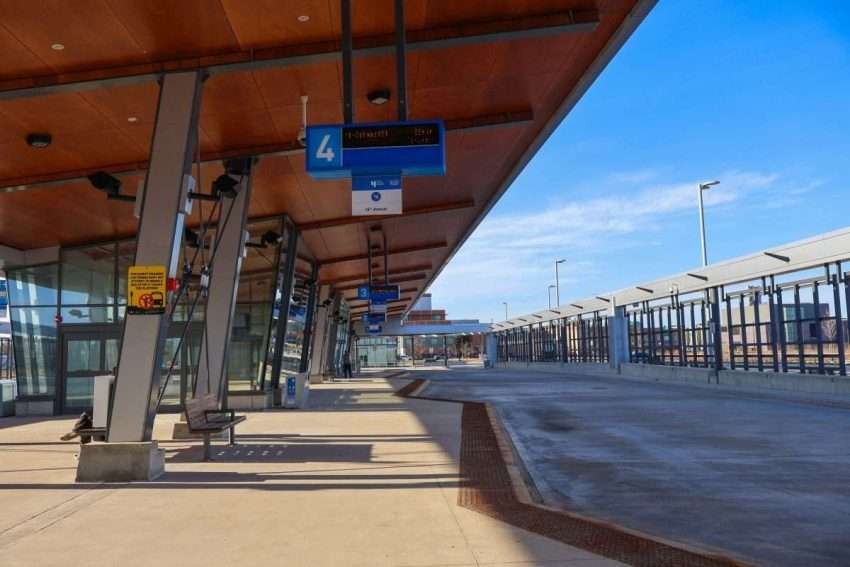
Photo: York Region Transit has made several changes to improve its services since COVID-19, such as building the Cornell Bus Terminal. (David Yin photo)